
Pima County Directory Collections
Tucson's first known city directory appeared in 1881. Publication was intermittent at first and became generally annual after 1899, though exceptions remain. Pima County Public Library reports that its holdings, combined with those of the Arizona Historical Society, Ancestry, and Arizona Memory Project, account for every extant Tucson directory year through 2003. That statement describes all surviving issues across several repositories, not one unbroken shelf. A missing year at one library may exist online or at another archive.
| Directory collection | Known span | Repository | How to consult it |
|---|---|---|---|
| G.W. Barter, Directory of the City of Tucson | 1881 | Arizona Historical Society and Arizona Memory Project | Free digital PDF |
| Tucson Directory Co. | 1917 confirmed | Arizona Memory Project | Free OCR and page images |
| Cole and R.L. Polk volumes | Public year-by-year list unavailable | Joel D. Valdez Main Library | Noncirculating reference use |
| Combined extant Tucson run | 1881-2003, with gaps | PCPL, AHS, Ancestry, and Arizona Memory | Mixed online, onsite, and library-login access |
| UA campus directories | Print to the 1920s, earlier on microfilm | University of Arizona Special Collections | Onsite, noncirculating |
The Pima County Public Library city directory service explains the current access choices. Its screenshot below shows the library's city and criss-cross directory guidance. The service matters because it links remote searches, phone help, and the physical collection instead of treating the books as online-only records.
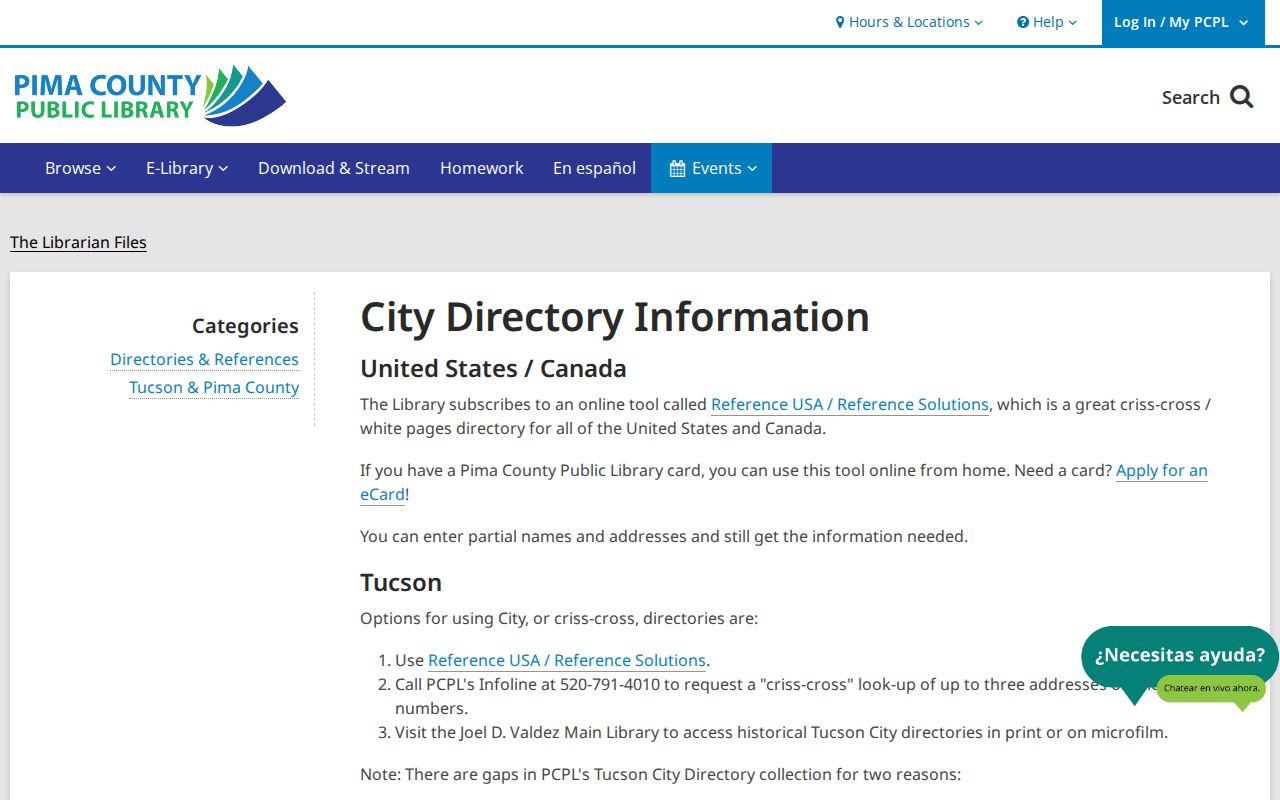
Use the combined run as a map of possible evidence. It does not prove that every year survives, that every resident was listed, or that every volume has a reverse section.
Pima County Directories Followed Rail
The directory record begins at a telling point in Tucson history. Southern Pacific arrived in 1880, and the first directory followed one year later. That close timing makes the 1881 book more than a list. It catches a territorial city as rail travel changed trade, migration, and the pace of growth. Later volumes span statehood, new suburbs, and the shift from compact street grids to a far wider urban area.
Local history also explains why names need flexible searching. Tucson grew from Indigenous settlement and a Spanish presidio through Mexican and American periods. Older indexes may drop diacritics, split or join Spanish compound surnames, abbreviate given names, or use Anglicized forms. Try the spelling in family papers, then plausible joined, spaced, and unaccented variants. Treat the result as a lead until another source confirms the person.
The library's Tucson directory history pairs the long run with striking snapshots: civic claims, phone counts, hotel lists, and the health trade. Such material places a resident inside the city they knew, rather than leaving a bare name and address.
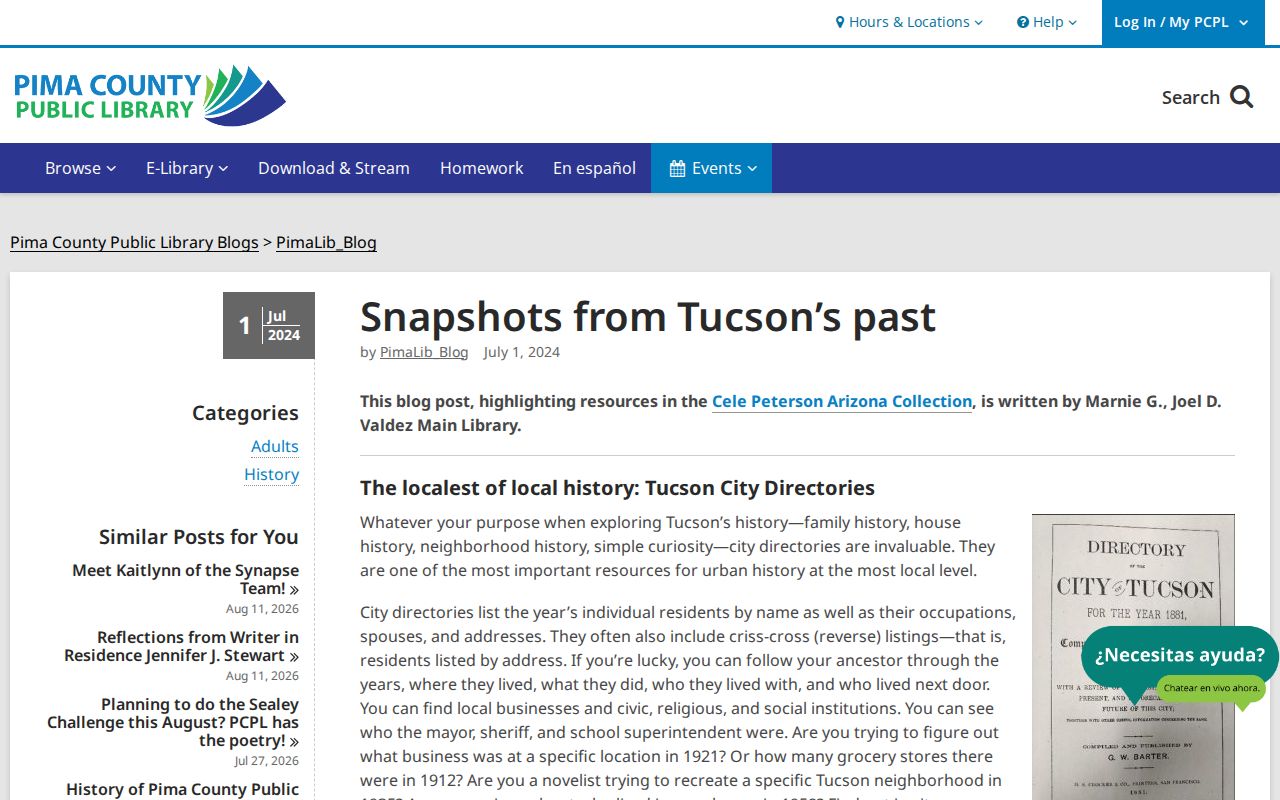
The pictured library feature connects surviving volumes to Tucson's changing streets and daily life, a useful frame for family research.
Access Pima County City Directories
The fullest local route is the third-floor reference desk at Joel D. Valdez Main Library. The Cele Peterson Arizona Collection is noncirculating, but patrons may read, copy, and photograph material subject to condition and copyright rules. Print volumes, microfilm, Tucson telephone books, Cole and Polk reverse directories, and local newspaper microfilm can be used together. Confirm the shelf location before a visit because Pima County approved a replacement downtown library building in 2025.
Distance does not end the search. Infoline at 520-791-4010 performs up to three address or phone criss-cross lookups. Give staff a directory year or a narrow range when possible. Cardholders may also use Reference Solutions for contemporary partial-name and partial-address searches. Selected historic scans and OCR appear through Arizona Memory Project, including 1881, 1903-04, and 1917.
Library desk
Consult city directories, phone books, reverse volumes, and newspaper microfilm at Valdez Main.
Phone help
Request up to three focused criss-cross lookups through PCPL Infoline.
Digital route
Search selected scans and OCR through Arizona Memory Project and library databases.
Arizona Historical Society and University of Arizona Special Collections are fallbacks when the public library lacks an issue or when a name belongs to a manuscript collection rather than a printed directory. Both require planning: AHS holdings are only partly online, while UA physical collections are open to the public but noncirculating.
Note: A remote criss-cross answer identifies one volume's entry, not a complete history of the household or address.
Read a Pima County Directory Entry
A typical Pima County city directory entry can supply a resident's name, spouse, occupation, and street address. Later reverse sections turn that arrangement around and list addresses in street order. The exact fields and short forms change by publisher and year, so the front matter and printed key control interpretation. Do not assume a mark seen in one edition carries the same meaning in another. PCPL did not support a universal owner, renter, or widow symbol across the full run, so those details should never be added from memory.
| Name | Start with the printed form, then note initials, variant spellings, and other people at the same address. |
|---|---|
| Spouse | A named spouse helps separate residents who share a surname and first initial. |
| Occupation | Work can distinguish two similar names and connect a person to an institution or trade. |
| Address | Record the number, direction, street wording, and any unit exactly as printed. |
| Street-order listing | Later reverse sections may show other listed names nearby and reveal address continuity. |
- Criss-cross directory
- A reverse directory arranged by street address or phone number rather than by surname.
- Householder index
- An address-based list that points from a place to the person or household printed there.
- Abbreviation key
- The publisher's legend for shortened names, work terms, and address notation in that edition.
Copy the page title, year, page number, and entry. A clipped name without the edition can be hard to verify later. By 2003, occupations had disappeared from the local directories, while street maps, carrier routes, and neighborhood demographics had gained space. A blank field can therefore reflect the publication's design, not missing facts about the resident.
Inside Tucson's 1917 Directory
The 1917 volume shows how much structure hides inside a city directory. Its Street Guide occupies pages 13 through 18, followed by alphabetical residents on pages 19 through 209. County officials appear on pages 210 through 215, city officials on pages 216 through 234, and an advertiser index follows. The publisher estimated Tucson's population at 23,375. That was an estimate from the directory company, not a census count.
The street guide is also an address conversion tool. Stone Avenue divided east and west numbers, while Congress Street divided north and south. The volume records that Annie Avenue became Anita and Belknap became North Scott. When an ancestor's street seems to vanish, check the guide before concluding that the household moved.
| Directory era | Research clue |
|---|---|
| 1881 | First known Tucson directory, one year after rail arrived. |
| 1899 onward | Generally annual publication, with exceptions and surviving gaps. |
| 1917 | Street guide, resident pages, officials, and explicit former street names. |
| 2003 | End of the combined extant Tucson directory run reported by PCPL. |
Trace Family in Pima County Records
Family history works best when each Pima County city directory entry becomes a dated checkpoint. Start with the strongest known year and keep a research log. A spouse, occupation, or exact address can separate two people with the same name. Adjacent issues then show whether the household stayed, moved, changed work, or disappeared from the printed record.
- Find the person in an alphabetical section and copy the full entry, edition year, and page.
- Check the prior and next available issues. Record every change in spouse, work, and address.
- Use the reverse section, when present, to confirm the address and see other listed households nearby.
- Pair the directory checkpoint with the 1950 or earlier federal census, whose public schedules follow the 72-year release rule.
- Continue through phone books, deeds, newspapers, obituaries, and probate when the printed run ends or the person disappears.
An absence proves little by itself. A person may have moved, died, chosen not to list, been missed, or appeared under another spelling. Census schedules show a household at one census date, while directories can add checkpoints between decades. The National Archives census guide explains schedule access. For the modern address-based chain, the Pima County street directory owns the parcel and current-record workflow.
Research habit. Cite every directory year separately; a later transcription can hide the spelling, layout, and neighboring entries that resolve identity.
Pima County Directory Gaps Need Companions
Returned rental criss-cross volumes created real gaps in the library collection, and early publication was never perfectly regular. Companion sources fill different parts of the story. PCPL's genealogy resources include Ancestry Library Edition onsite, HeritageQuest, the Arizona Digital Newspaper Program for 1859-1922, later newspaper databases, and HeritageHub obituary coverage. These do not turn a directory hint into an official fact, but they can explain a departure, confirm kin, or place a person at an address.
Deeds and probate help with ownership and heirs. FamilySearch catalogs Pima deed indexes from 1858-1922 and deeds from 1866-1921, while probate journals begin in 1864 but have early gaps and missing filmed volumes 11-14. The PCPL genealogy collection is the natural first companion stop. For a house rather than a person, use the Pima County previous residents search to follow the deed chain backward.
Newspaper and obituary text is family- or publisher-supplied evidence. Compare dates and relationships with certificates, probate, or recorded instruments. That cross-check is vital when the directory entry uses only initials.
Pima County Archives Beyond Directories
The Cele Peterson Arizona Collection gathers the physical context that digital name searches lose. Alongside city directories sit Tucson telephone books, local books, and late-1800s newspaper microfilm. The library's Arizona Collection feature introduces this noncirculating research room.
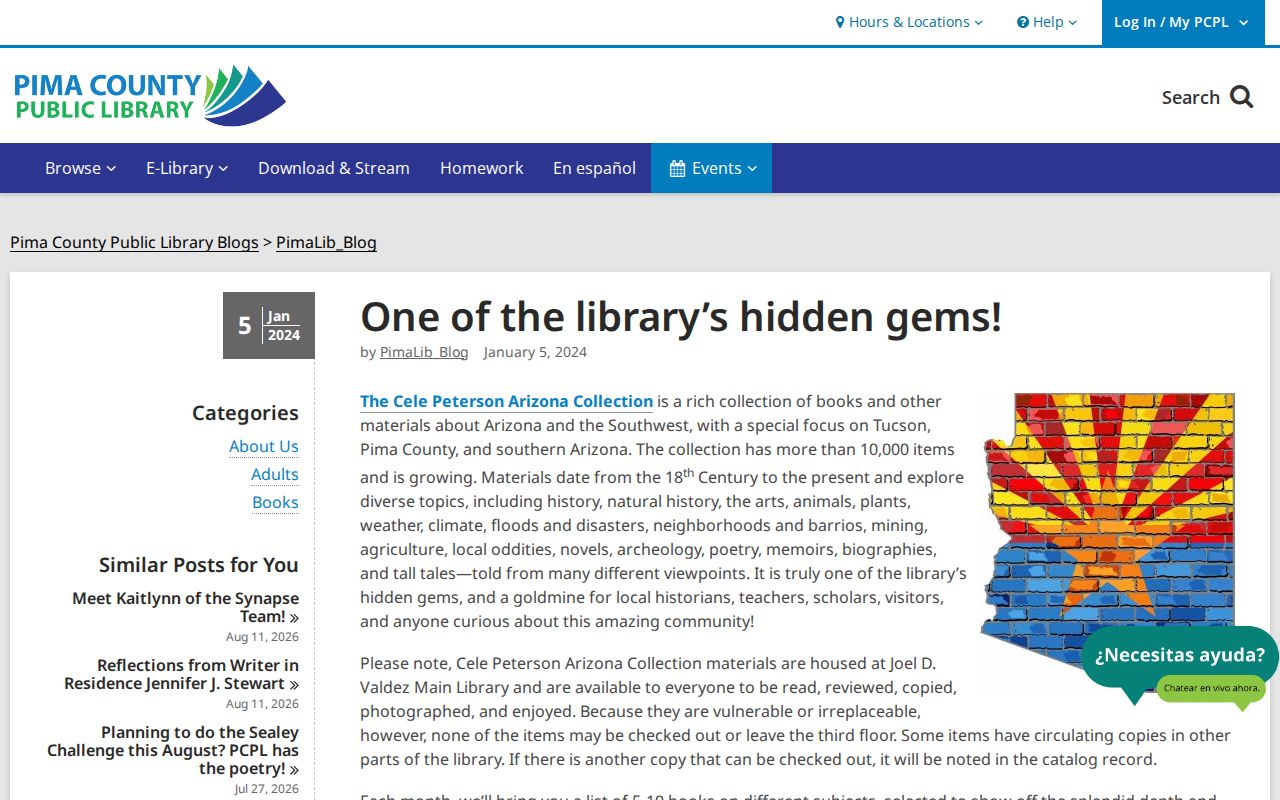
The collection is especially useful when a city directory provides a clue but not the answer. A telephone book can extend the address trail, while newspaper microfilm may explain a move, business, death, or family link.
UA Special Collections adds biographical files, Alianza Hispano-Americana records, photographs, oral histories, and family papers. AHS adds manuscripts, diaries, letters, maps, and books reaching back to the 1700s. Search finding aids first, then contact staff about access and duplication. Physical materials at UA are open to public research but do not circulate; AHS appointments are often needed.